Denise Bogard brings it in her critique of Bevans Chapter 9 and how Bevans: "...errs in its tendency to centralize 'community' over and above the gospel itself. (This is not to belittle community as a central part of the Christian life, but only to assert that it is a rightful outflowing of the gospel, rather than its source or its equivalent)."
Denise, since you've sat behind me the entire quarter and have been a great small group partner in conversation and presentation, I feel obligated to chime in on a blog of yours before the quarter wraps. In regards to Bevans, I would wholeheartedly agree that community should flow out of the "gospel" rather than visa-versa.
But I believe this is where the Church has gotten it wrong [for the most part], and the new "Emerging Church" has gotten it right. The Emerging Church emphasizes the biblical principles behind mission, church planting, outreach and community endeavor. Critics of the emergent movement believe that many modern church initiatives lack true biblical grounding, choosing community over gospel truth, whilst traditional churches often lack both and that their way is the middle way. And like Denise, I believe God's story in the Gospel message is a powerful one.
That being said, I tend to fall on the side of something new rather than something old... even if this fuzzy image of community over truth is part of the package. It all comes down to the old not resonating with people who have been "burned" by the Church. And because sometimes the doors are closed by the elements of our fallen world, I'll side with community and believe that God's story can be seen through the lives and love of God's people.
Tuesday, March 11
Response: Denise's Blog [Week 10]


Thursday, March 6
Reading: Bevans [Conclusion]
Is one model better than the other? Bevans has broken down five different models of contextual theology, each with both it's pros and cons. He also reminds us that each example of the individual models do not stay exclusively true to their model but borrow a little from other models as they apply their personal influence on the particular community they evangelizing to.
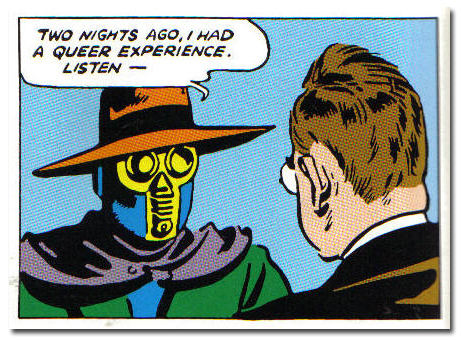
Bevans ends his book appropriately by mentioning that "within today's world of radical plurality and ambiguity, the best answer to the question can only be: 'It depends on the context.'" The context of this comic book illustration becomes funny due to it being out of context. Context, context, context. A text without a context is a pretext. The context of scripture, of course, but also the contemporary context—the Bible in one hand, the broadsheet in the other. The clash of two worlds: scriptura probat mundum.
Thursday, February 28
Reading: Bevans [Transcendental]
Bevans summarizes that the transcendental model of contextual theology points to a new way of doing theology. The model highlights the active, never-ending aspect of Anselm's definition of theology as faith seeking understanding. 
Although the argument is logical in its construction, the critique doesn't hold much weight when you consider that overall every theory is just that, a theory, until put in action. As a wise Jedi once said: "No! Try not. Do. Or do not. There is no try!"
Thursday, February 21
Reading: Bevans [Synthetic]

Friday, February 15
Reading: Bevans [Praxis]
Bevans has moved from the translation model of contextual theology focusing on Christian identity within a particular culture to an anthropological model focusing on the cultural identity of Christians and their unique way of articulating faith. In Chapter 6, the praxis model is unveiled, focusing on the identity of Christians within a culture as that culture is understood in terms of social change. Movement from knowledge to action is the backbone of the model, founded on liberation theology, known as a practical way of thinking that directly effects everyday life.
Friday, February 8
Reading: Bevans [Anthropological]
Bevans busts out his spin on the anthropological model of contextual theology in Chapter 5 of his MP520 opus. Even before I learned about the details and theories like the anthropological model in my studies here at Fuller, I had an understanding that I was a unique creation of God's with my own path on Earth. Maybe I didn't understand that the method involved terms like "human nature" or "human culture." And I certainly didn't [and probably still don't] know what it meant to be "fully human." That being said, one could look at the war, hate, and ugliness on the Earth and claim the goodness of humanity is damned. Of course, on the flip side, another could argue there is goodness in love, faith, hope, and progress made each day. Is your glass half full or half empty?
Thursday, January 31
Reading: Bevans [Translation]
When I first think of the word translation, in response to the translation model of contextual theology as explained by Bevans, personally think of the Greek and Hebrew translations of the Bible. Also know as, the primary reason I am in the MAT program instead of a MDiv student. I'll be honest, larning new languages scare me a little. I barely passed German in High School and didn't have to take a language during my undergrad over 10 years ago because I was able to test out of some math classes.
So when Bevans speaks of the translation method, I can relate from my experiences coordinating Sunday services where I took biblical text and created new and experiential ways the church goer could experience and understand the text, but beyond that not much in the way of languages. Basically, I can translate the English text to a current cultural setting better than most. But if you asked me the Greek root of eschatology, I'd be lost.
Thursday, January 24
Reading: Bevans [Models]
 Bevans' main point in Chapter 3 is the importance of models are metaphors and they often only make sense when another model is used. It is interesting to look back on your education and growth in and around the Church and realize how my personal beliefs and faith has risen like a phoenix out of the ashes of the model or denomination I was brought up in.
But that is as far as I'd like to go on the subject, whereas Bevans apparently would like to drive the point home until I fall asleep reading. Very well, Bevans. I shall accept your chal... Zzzzzz...
Monday, January 14
Reading: Bevans [Issues]
Bevans' last point was the most interesting to me in his admittance that the word contextualization is the best way of describing aspects of context such as social location and particular experience, including the history, innuendo, and realities of older terminology of the same ilk including inculturation, indigenization, or incarnation of the gospel. That words can have a depth of history, both positive and negative, that may influence ones reaction towards a term is a significant element we cannot ignore.
- Main Entry: cor·po·rate
- Pronunciation: \ˈkor-p(ə-)rət\
- Function: adjective
- Formed into a corporation; incorporated: the corporate companies of industrial America.
- Of or relating to a corporation: corporate assets; corporate culture.
- United or combined into one body; collective: made a corporate effort to finish the job.
- Of or relating to a corporative government or political system.
Personally, the word corporate is a popular term being thrown about in today's postmodern and/or emerging church. The church today uses the term corporate according to third definition of a "united or combined into one body; collective"... but for someone like me who worked in the industrial business section climbing the "corporate ladder," the word carries an unwanted weight. Now obviously we can't go around tiptoeing around wrods all day. But it bears repeating. Wait... unless that someone you are speaking to survived a bear attack...
Friday, January 11
Reading: Bevans [Contextual]
Bevans believes that Evangelii Nuntiandi, Paul VI sums up contextual theology the best when he says that evangelism must speak to every aspect of human life. I'd agree with them to a degree, since when viewing the human experience today in all of it's glory and trouble, can be both a edifying and harrowing experience. If we study the theology in relation to history and it's particular context to why it was written, we place our own human experience into Scripture. It's human nature to reflect oneself into what one is involved in. Revelation plays a huge part in this concept of theology. I do believe the Spirit is involved in translating the Word of God into a living Word, something that can speak into individual lives and meet them where they are and for what they need. We cannot limit the power of God or the Spirit at work in our lives and in Scripture. To say that one understands how God or the Spirit works is a huge stretch and a dangerous path to take. Read Job again and you see the cosmic struggle that is bigger than anything the human mind can imagine.

